Since it's a little tricky, I figured I'd share the basic info on how to get back to the airport with any readers loyal enough to get this far (And thanks for reading). Keep in mind that this may change by the time you study here, but as of now:
The best option is to first take a bus (the usual #12) from the dorms down to Hirakata Station (220 yen). Once there, walk to the side of the station with the StarBucks, then follow the main road out a few blocks till it hits a busy street. Cross, then walk forward a bit farther: off to the left is a small brow roof for a bus stop; that's your destination. Ask about the schedule at the dorms before hand. The bus here goes straight to the airport, and costs about 2000 yen. As with all travel, be sure to leave yourself some margin for error.
That's all for now, though there may be a few more posts once I've recovered, readjusted, and remember experiences I forgot to type up. Till then, farewell!
Looks like I have at least one more post before the end. December was hectic, with classes drawing to their end. It stayed fairly warm until the last week, but as I write this it is truly cold outside.
My room mate left yesterday, I'll be leaving tomorrow. I already miss him, and the other friends and familiar people I'll be leaving. I had a home here for this semester, a good one, and it's a profoundly sad experience to look around and realize I'm saying goodbye to everything I see.
But at the same time I have a very real sense of satisfaction, of seeing a lot, doing a lot, learning a lot. Being here this semester has been a chance to connect with Japan, and the world in general, in an amazing way. That's actually one of the reasons it's so hard to leave, because leaving means going back to a much less interesting life.
But a lot can change with effort and luck. It won't happen overnight, but I'm resolved to do what I can to recapture some of the freedom and engagement I've had here back at home.
So while many of them may never read this, a thanks to all my friends throughout this semester: Yutaro, my speaking partner, Kristen, Eddie and Brian, Jen, Don. The people whose faces I know but names I don't. The "Mother" and "Father" caretakers at the dorms, for their tireless work. Our RA, Hiro. I'll even miss the assholes. Thanks for the great semester, and best of luck to you all.
I'll try to get some pictures up later, if I remember.
Type rest of the post here
My posts have been rapidly decreasing here as the end draws near. One more thing I've learned from my time here: the end of the semester sucks no matter what country you're in. It's hard to take in the wonders of another culture when papers, finals and projects are closing in from all sides. And getting sick just as all this starts doesn't help either.
I've been reflecting a lot on my semester here, now that it's almost over. In some ways I wish I could have gotten deeper, done more, learned more. But I suspect most people wish the same thing. As long as a semester is, it's really only enough to begin learning about a country. There's only so much a person can do in four months, especially while in school.
For all I was able to see, too, there was a lot I simply couldn't be a part of because I didn't have the language skills. This isn't to say Japan isn't friendly to English speakers: Quite the opposite. It's been amazing to see how many places English labels and directions crop up, and the amount of Japanese people that can speak at least basic English when my Japanese fails. What little Japanese I know has also been handy from time to time.
It's just that for all I was able to do, there was more I wanted to do, and language does form a substantial barrier.
Still, I'm glad I was able to travel, to see some incredible temples and cities, and run through some awesome geek scenes. I'm also grateful for some of the other students, who I've been able to form a tight network of support and fun with here (mostly through the dogged kindness of one, and the incredible awesomeness of another). You don't realize how great it can be to have friends who share your interests until you actually have them.
So this is my official reflective post. We'll see what I have time for from now up to the end. Stay tuned!
At the back of the CIE building on campus (where all our classes are held), near the mailboxes are a few tables, scattered with various magazines, pamphlets, and these. For some in-explicable reason, they're called "beans." They're sturdy notebooks, wherein students are encouraged to write, doodle and screw around as kind of a cultural, communal sharing exercise. I saw them the first few days I was on campus and thought "Interesting idea, but no one's ever going to bother using them."
How wrong I was.
A few weeks ago a casual flip through them revealed a treasure trove of doodles, written stuffs and a hodgepodge of other things, the pinnacle of which was this, drawn in classic xkcd style:
I'll just post a few others after the jump and let them speak for themselves. There's more on Flickr. Oh, and keep reading for the Haikus.
Not far away, the entries for a local Jr. High school's haiku contest have been posted, and they're nothing short of amazing. The English in many is dead on, the poetry is often actually fairly clever, and the art (despite being obviously copied in some cases) is impressive. Take a look:


Last weekend my Buddhist art class went on its last field trip for the semester. We saw Temples, tea houses and some incredible gardens. And after that, I and a few friends went to yet another temple that was in the area. Let me see if I can keep them all straight...
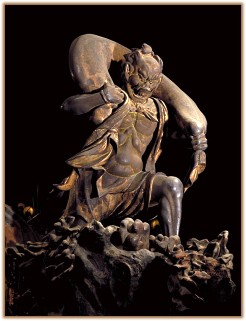
Our first stop was Sanjūsangen-dō, or 1000 Buddha hall. Aptly named, because inside the main building, standing on a long row of stairs, are 1000 Buddha statues, surrounding one massive one in the center. Unfortunately no pictures are allowed inside the building, but there are some photos on the wiki article that give you an idea. It's a long, long space. The figures are tarnished now, but would have been brilliantly gold when they were new, and the whole front of the building is sliding paper doors that face east. With the sun shining in in the morning, the place would have been almost blinding.
The best part though is the carved guardian deities that stand in front of the army of Kannon Buddhas. They're incredibly expressive and unique, especially my favorite, Fujin.
Next up was Daitoku-Ji, a Zen Buddhist temple, and the surrounding grounds and subtemples. The area is beautiful, and amazingly quiet. Most of the time the only sounds were the footsteps of other visitors and the wind, mixed occasionally with the chanting of monks.
We also visited two sub-temples. The first was Daisen-In, home of a famous rock garden. Again, unfortunately no pictures allowed. Many readers probably know the gardens are used for meditation: what they may not know (and what I didn't) is that they're designed to mimic Chinese landscape paintings.
The second was Koto-in, which is entered through a long pathway amidst Bamboo and surrounding by a wide, intricately cultivated garden. Paths wind back and forth through the bushes and flowers, wide raised stepping-stones above the layer of moss that covers the ground everywhere. Between the quiet and the beauty, it's almost possible to believe you've gone back in time. If it wasn't for that guy on his cell phone.
Finally, we stopped at Kinkaku-ji, the Golden Temple. As far as I know, that's really gold leaf on the building. The leaves were just turning as we visited, and the effect was amazing. Kinkaku-Ji is easily the most beautiful temple I've seen so far in Japan.
2010 is the Year of the Tiger on the Zodiac, my year in fact, so I got this adorable tiger at the gift shop. I was pleasantly surprised when I unpacked it: I thought I was only getting the tiger, not all the other props. 
The buses were packed on the way back: this trip was the first time I actually experienced the famous crammed transportation of Japan. Many, many more people can fit on a bus that you'd think. Still, we got where we were going, and the day was an overwhelming success.


I'm just about to go see this week's film, so what better time to finally write about last week's? Uzumaki is a j-horror film based on a shoujo horror manga series, ie, a series for teen girls. Yes, there is an entire genre of horror comics in Japan written for teen girls. And some of them, Uzumaki included, are pretty creepy.
Uzumaki means spiral or vortex, and the film's story centers on a small, rural Japanese town cursed by a dark force associated with spirals of all kinds. The slumbering evil gradually awakens as the film goes on, transforming an ordinary community into a twisted netherworld. As horror goes, this is a pretty standard plot, but the details are what make Uzumaki worth watching.
The director's treatment of the story always hovers between true horror and a comical, "Army of Darkness" parody of genre's absurdities, but never goes too far in either direction. As a result, Uzumaki is full of dark humor, while at the same time also managing to achieve some truly scary moments.
A certain amount of gore is present, but the impact of much of it is softened due to its use as a comical prop. The characters are fun to watch, if also very stock: A school-girl, her love interest, his father (the crazy-guy-who-kills-himself-and-becomes-supernatural-evil), the hard-boiled reporter that's trying to unravel the town's secret. Ultimately though, it's the constant fluctuation between horror and comedy that keeps the film alive: too much of either and Uzumaki could easily become unwatchable, either through boredom or horror that's simply too over the top.
The cinematography is rich and pulsing, if a bit hokey. But again, with the emphasis on comedy, the often cheesy or hilariously overdone visuals fit the film just fine. It's also a good film for those with short attention spans. Japanese Cinema is often slow-moving with its story, but Uzumaki keeps up a steady, if not exactly frantic pace. I look forward to watching this one again, and/or reading the manga, which has a somewhat longer plot.
Image used under fair use.

There was no school Wednesday, so the small band of friends I hang with here decided to go to Kuzuha mall, a shopping center a few stops from Hirakata. It's a pretty big mall, but most of the shops are boring clothing stores. Hidden away on the third floor, however, there are two excellent places: a retro, 70s-80s Americana shop (Yes, irony) and something a bit like a Spencers (Hodgepodge of electronics, merchandise for various franchises and random knickknacks), but Japanese. I got a couple things, including the watch shown above. A pretty fun way to spend a Wednesday.
For the sake of a paper I'm writing, I rushed down to Nara last Monday. That was the reason for the rush anyway: Nara is a reason all in itself. After the object of my quest was found and photographed (and a bit before as well) I had time to wander a bit, and I'm glad I did. The area is easily the most beautiful I've seen in Japan: ancient architecture, vast open fields as one temple ground flows into the next and of course lots and lots of deer.
For those not familiar with Nara, the whole area is filled with deer, who are allowed to roam freely and have absolutely no problem harassing people for food. They also squeal and howl to each other in a very amusing way.
More pictures below...

A pond near Todai-ji, and the path near the lanterns I posted at the top. Nara is beautiful.
The main event: Todai-ji's "Daibutsuden" or "Big Buddha Hall." Aptly named, because it houses this:
Don't let the lack of context fool you: the hand you see there is easy seven feet tall. The statue is enormous.
Despite the size of the Buddha statue, there's lots of space left around him, and the hall also holds many other incredible bits of art, like this mouth (which I suspect used to be part of the exterior decoration) and these moths/butterflies.
And this is the (academic) reason I came. Binzuru, one of Buddha's original followers, said to be good with magic/psychic powers etc. Rubbing him, then a part of your own body that's in pain is supposed to have a healing effect.
That's all for now. More, as always, on Flickr.


Next up is Takeshi Kitano's Hanabi. Though we were warned of it early on, one thing that's becoming increasingly clear is that "Beat Takeshi" is in a heck of a lot of Japanese cinema. As he's one of the most interesting and capable actors we've seen so far, this is a very good thing.
The movie itself is a grim tale pierced by a few rays of light. Takeshi's character is a rough-edged cop, too disturbed by the brutal murder of his fellow cops to stay on the force. His wife dying and his pockets empty he fixes on a plan: rob a bank and use the cash to propel him and his wife through one last trip before the end as the Yakuza (demanding interest on an old loan) and one of Takeshi's former co-workers (hunting him after the robbery) start to close in.
Takeshi actually has a long and interesting story behind him. He started out doing comedy under his "Beat" handle, then slowly worked his way through the industry, first as an actor, then director and often, as in this film, both. The characters he plays and the stories he chooses to tell stand in sharp contrast to his comedic work. Though there's some variance, nearly all his roles are deeply serious, skilled no-nonsense lone wolves taking on all comers. There's a certain Clint Eastwood vibe in the men he plays, though that only partially explains it. The humor, for its part, is still there, tucked away, waiting for an opportune moment to peek out.
The film is dark, but at the same time positive. Takeshi's character breaks one set of rules, but perhaps it's to stay inside another set. The acting is powerful and subtle: whole scenes go by with almost no dialogue at all, yet volumes are being communicated in looks and movements.
In all Hanabi is far from my favorite film this semester, but it's worth watching for Takeshi's performance alone, which is (as far as I've seen) his best yet.
Image used under fair use.
Our field-trip last weekend took us to two temples, Byodo-in and To-ji. Keen observers will notice we're traveling forward in time with these visits, and the "newer" the temples, the more impressive they become. Byodo-in and To-ji specifically make an interesting pair, because while both are breath-taking, they are so in almost exactly opposite ways.
Byodo-in actually started its life as a summer house for the royal Fujiwara family, and was converted into a temple some time later. Perhaps as a result of this, the actual temple building, while beautiful, is somewhat small and un-impressive compared to many temples: the vast Buddha almost seems cramped in its center room. The real strength of Byodo-in lies in its lush, vast, incredible surroundings, which still remain somewhat similar to their original period look, a rarity in Japan. On reason for this preservation, in addition to the temple itself, may be the association with the famous Tale of Genji which, if I'm remembering right, is set in roughly the same time and place. In any case, the beauty of the wide river, hills and long bridges leading to Byodo-in cannot be overstated.
And of course, for all my criticism, the temple itself, the Phoenix Hall, is pretty amazing too.
To-ji, meanwhile, retains none of its surroundings whatsoever: everything outside the temple walls has gone very, very modern:
But inside there is no mistaking the seriousness of the creators or maintainers of the complex. The grounds are wide and mostly empty. The buildings are massive and ominous, towering over the visitor like brooding storm clouds. In some of the buildings sit Buddha images that put the Byodoin image to shame with their size, and a whole host of others only slightly smaller, yet the buildings never feel too small.
The massive main gate.
Closeup on the doors, and a detail from inside.
One of the smaller shrines inside the temple.
The star of the show: To-ji's massive pagoda, visible even from the train station several miles away.
Entrance on one of the other buildings. Kondo maybe?
One last thing before I finish: please, check out the Flickr. This was one of the best rounds of pictures I've taken here, and there's simply no way to cram them all into a blog post. These are just the highlights. So if you only check out the flickr account once, do it for this set.